

For most private hospitals, the goal isn’t simply to bring in more patients. It is to drive sustainable revenue growth that comes from continuity of care and long term patient relationships.
You can’t achieve that by simply waiting for referrals or running sporadic ad campaigns. The modern healthcare consumer is researching, comparing, and validating their choices long before they ever pick up the phone. To increase patient acquisition, you need a strategy that turns self-directed consumers into loyal, retained patients.
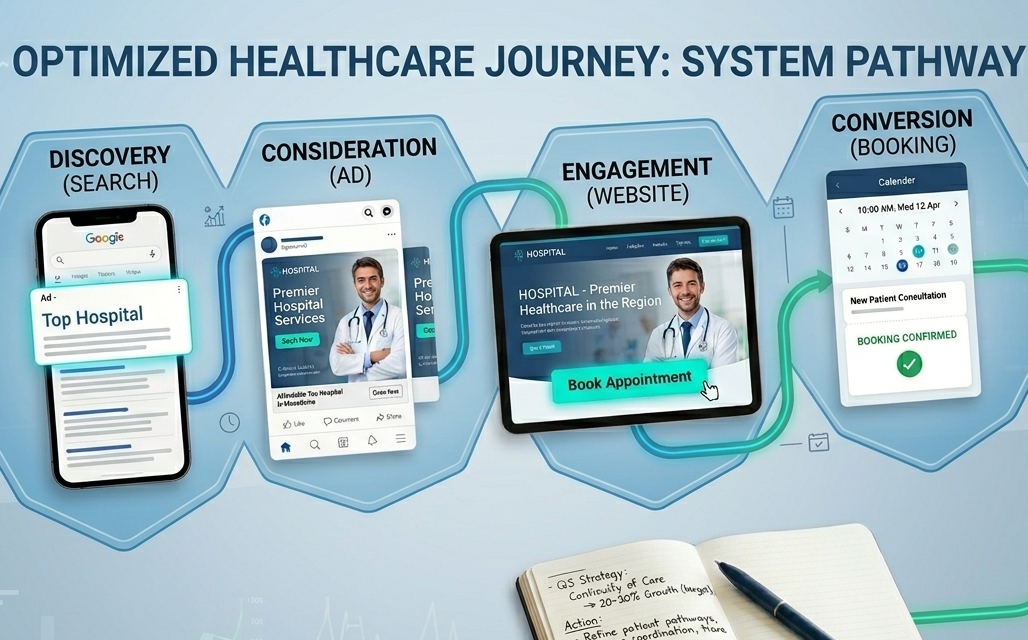
At EMIT Knowledge, we’ve seen partner hospitals achieve 20-30% growth by moving beyond isolated tactics to a continuous, data-driven approach. Here are seven effective ways to build that system, combining strategic marketing with operational execution.
1. Build a Clear Picture of Consumer Demand (Before You Spend)
You can’t acquire patients if you don’t know where they are looking. The first step to effectively increase patient acquisition is to understand the actual demand in your market.
Stop guessing. Use data to identify what services patients are searching for, the volume of those searches, and the specific language they use. This isn’t about vanity metrics; it’s about investing your marketing budget where it can create measurable impact. When you know exactly what your target segments are seeking, you can develop buyer personas and tailored content that speaks directly to their needs, and you can do it before your competitors do.
2. Recover Lost Revenue from Incomplete Bookings
A significant portion of patient acquisition happens and then breaks, during the booking process. A patient might find your site, research a doctor, and start an appointment request, only to abandon it due to a clunky form or a lack of immediate follow-up.
This is lost revenue that you have already “spent” marketing dollars to attract. To truly increase patient acquisition, you must implement workflows to recover these incomplete bookings. Whether through automated, personalized follow-up or a structured recall process, converting that abandoned intent into a scheduled appointment is one of the fastest ways to improve doctor calendar utilization and boost revenue.
3. Create a Balanced, “Always-On” Channel Strategy
Sporadic campaigns make it easy for competitors to capture your audience. When your ads or content disappear for weeks at a time, you leave high intent patients with no option but to choose another provider.
To increase patient acquisition consistently, you need an “always-on” presence across a balanced mix of channels: programmatic advertising, paid search, and targeted social media. This does two things. First, it ensures you are visible wherever the consumer is searching. Second, it builds brand awareness with passive consumers, so when they do need care, your organization is the first one they remember.
4. Speak Their Language with Compelling Calls-to-Action
Your calls-to-action (CTAs) are the bridge between consumer interest and a scheduled appointment. If that bridge is confusing or weak, you lose the patient.
You need to speak the patient’s language. Instead of a generic “Contact Us,” use direct, relevant CTAs like “Check Appointment Availability” or “Discuss Your Treatment Options.” The best-performing organizations A/B test these CTAs to find what resonates. A well-designed, clear CTA placed at the right moment in the patient journey can significantly increase patient acquisition rates by removing friction at the final decision point.
5. Measure Referral Performance to Understand What Actually Works
Many hospitals operate on assumptions about which referral channels generate revenue. “We get a lot from Google” or “Our primary care network is strong.” But without measurement, you don’t know what’s actually driving profitable growth.
You need to track referral sources and, more importantly, their revenue contribution. This allows you to understand which channels generate actual booked appointments, not just clicks. By measuring performance, you can double down on what works and cut what doesn’t, ensuring that every effort is aligned with your goal to increase patient acquisition and revenue, not just activity.
6. Improve Patient Retention Through Structured Recall
Acquisition is expensive. Retention is where profitability is built. Acquiring a new patient only to lose them after a single visit is a leak in your revenue funnel.
A strategy to increase patient acquisition is incomplete without an equally strong strategy for retention. This means implementing structured recall workflows that ensure patients return for follow-up care, preventive visits, and ongoing management of chronic conditions. Continuity of care is not only better medicine; it’s also better business. When you improve retention, every new patient you acquire becomes more valuable over time.
7. Give Management Visibility into Operational and Growth KPIs
You can’t manage what you can’t measure. Most hospitals have plenty of operational data, but it’s often locked in silos, in the EHR, in spreadsheets, or in marketing dashboards, making it difficult for leadership to see the full picture.
To effectively increase patient acquisition, your leadership team needs a unified view of the patient journey. This means tracking KPIs like:
- Doctor utilization: Is your capacity being filled by new patients?
- Conversion rates: How many inquiries become scheduled appointments?
- Follow-up performance: Are you capturing recall opportunities?
- Referral revenue: Which channels are delivering the highest ROI?
When you turn operational data into management decisions, you can identify bottlenecks and growth opportunities faster and align your commercial and clinical operations around measurable goals.
Acquisition is a System, Not a Campaign
These seven steps work together. You can’t sustainably increase patient acquisition with a single campaign or a better website alone. It requires a system that integrates marketing intelligence, operational workflows, and executive visibility.
At EMIT Knowledge, we don’t just provide software. We partner with private hospitals to build this system. We help you recover lost bookings, improve retention, measure what matters, and turn patient journey data into decisions, all while integrating with your existing EHR and respecting privacy requirements.
If you are looking for a long-term partner who cares about your business outcomes as much as you do, let’s talk.