

What happens in the call between your patient and operator decides more than you think.
Private clinics are already generating enough patient interest. The real problem is that too many patients disappear before they ever become appointments, or after they’ve already visited once.
The frustrating part is that you rarely see the revenue you’re losing. There isn’t a report that tells you a patient visited your website and left without getting in touch.
No notification when someone calls but never books an appointment. No reminder that a recommended follow-up was never scheduled.
These missed opportunities often go unnoticed, quietly adding up over time.
It simply doesn’t happen. Over time, those missed opportunities turn into a significant amount of lost revenue that could have been captured with the right follow-up.
The five moments where clinics leak revenue
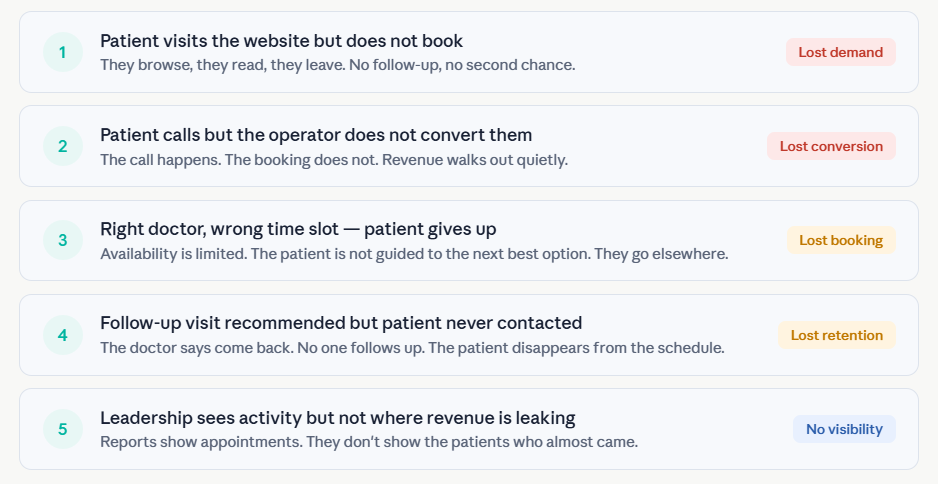
The diagram above shows the moments in the patient journey where things most often go wrong. Each stage presents different challenges, so improving them requires a different solution.
The first is the website visit that goes nowhere. A potential patient finds the clinic, reads through the services, maybe even checks a doctor’s profile and then leaves without booking. No one follows up. The moment passes. The patient books somewhere else that same week.
The second is the call that does not convert. This is the one we are focusing on today. More than 70% of patients interact with a clinic’s call center before they ever step through the door. That conversation is the first real human impression the clinic makes. When it goes well, when the operator is warm, informed, and guides the patient smoothly toward a booking, it works. When it does not, the patient thanks them politely and does not call back.
The third is the availability issue. The patient wants a specific doctor, a specific time and it is not available. Instead of being guided toward the next best option, they are simply told there is nothing. So, they go elsewhere. A clinic with a good patient flow process turns this into a managed conversation. A clinic without one loses the booking entirely.
The fourth is the follow-up that never happens. A doctor completes a visit and tells the patient to come back in three months. That instruction gets noted. But if there is no structured process to follow through, no reminder, no outreach, no touchpoint, a significant number of those patients simply do not return until something gets bad enough that they have to. Retention through follow-up is one of the most underleveraged growth levers in private healthcare, and most clinics barely scratch the surface of it.
The fifth is the leadership visibility problem. Clinic directors and hospital executives can usually see activity, appointments made, patients seen, revenue billed. What they almost never see clearly is where the demand went that did not convert. The patients who nearly came. The bookings that were almost made. That is what makes it hard to know what to fix, because the evidence of the problem is in what is absent, not what is there.
What the numbers look like at a typical clinic:
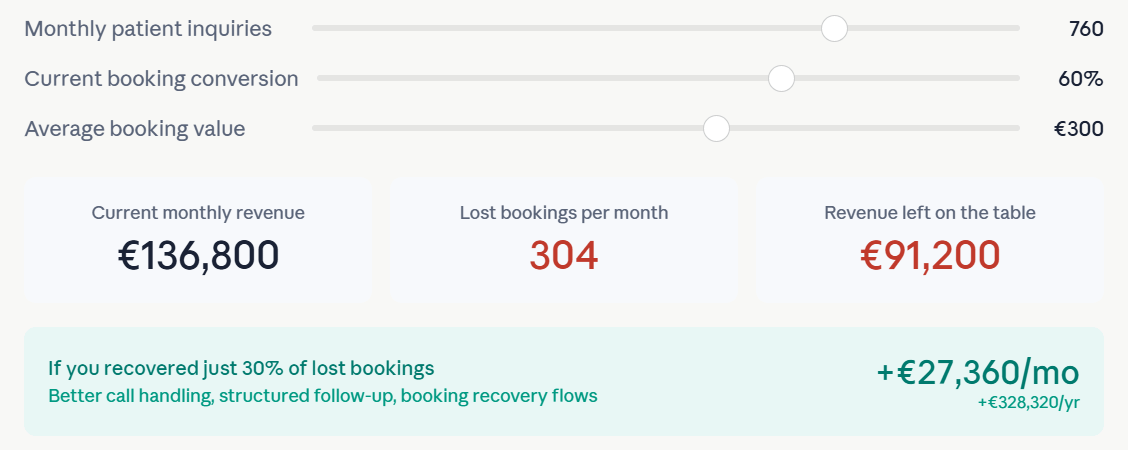
The image above makes this concrete. For a medium-sized private clinic receiving 700+ inquiries a month at a 60% conversion rate, almost half of that demand is being lost, and recovering even a fraction of it represents meaningful, recurring revenue growth without spending a single extra euro on marketing.
What actually happens inside a clinic’s calls
Think about what a good call center conversation actually requires. The operator needs to quickly understand what the patient is looking for, match them to the right doctor or service, handle availability constraints gracefully, reassure them that they are in the right place, and close the booking, all while keeping the conversation warm, human, and unhurried. That is a lot to get right consistently, across every call, every operator, every shift.
Most clinics manage this through training, instinct, and experience. Which works until it does not. Until a new operator joins and does not quite have the script down. Until a busy Friday afternoon leads to calls being rushed. Until a patient asks about a service the operator is not sure about, and the hesitation costs the booking.
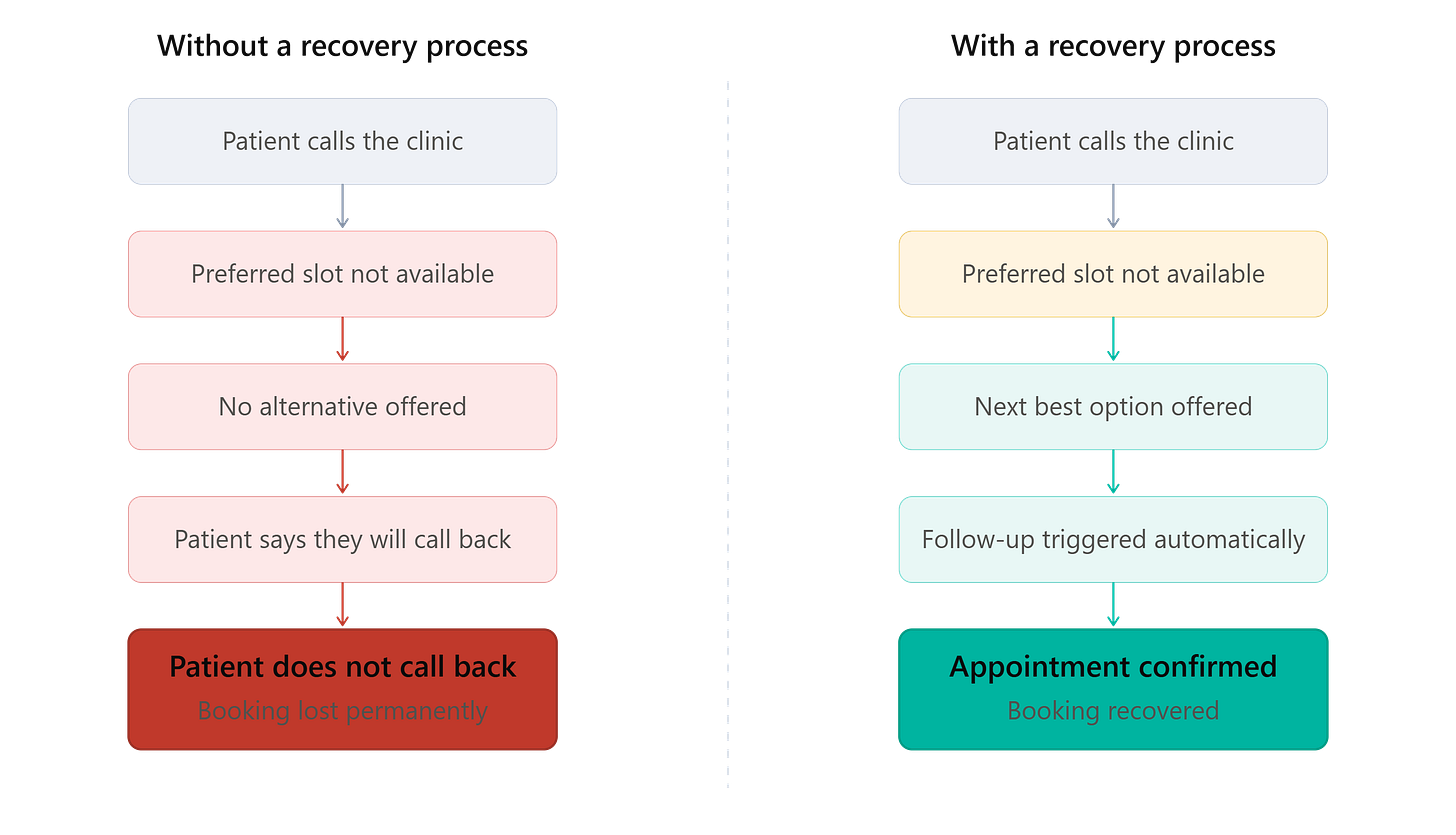
The diagram above shows how close a lost booking and a recovered one actually are. The patient interaction is almost identical, same call, same availability problem, same friction point. The difference is entirely in what happens next. In one version, there is no next. In the other, the clinic has a structured response: an alternative is offered, intent is captured, and a follow-up keeps the relationship alive until the booking lands.
This is what separates clinics that grow steadily from clinics that market hard and plateau. Not more demand, better conversion of the demand they already have.
What this means for hospital executives and clinical directors
For leadership teams, this issue often sits in a blind spot. The reporting they see tells them about appointments made, revenue billed, and patient numbers. It does not show the conversion rate from inquiry to booking. It does not surface the calls that ended without a next step, or the follow-ups that were never sent.
The goal isn’t to make things more complicated. It’s to understand where opportunities are being lost. Where are patients dropping off? Which parts of the journey create the most friction? What would happen if the call center converted just 10% more inquiries, or if patients received follow-up at the right time instead of not hearing back at all?
These are questions every hospital director should be able to answer. With the right systems in place, they can, and the revenue impact of getting this right is not marginal. It compounds, month over month, without any increase in marketing spend.
Looking to improve your clinic’s patient conversion and retention?
If you are looking to reduce lost bookings, improve call center performance, and give your leadership team real visibility into where patients are dropping off, see the end-to-end patient experience and growth platform PEX features.