

When operational challenges arise, they don’t appear out of nowhere. They build slowly: a call center conversion rate that decreases month to month, a rising readmission rate nobody spotted, a wait time that creeps up week by week, a marketing campaign that hasn’t delivered results, or a budget overrun hiding in a monthly report nobody read in time. By the time leadership sees the data, the damage is already done.
Private clinic and hospital leaders are expected to make fast, confident decisions. That’s impossible when the information you’re working from is weeks old, scattered across departments, or buried in reports. Real-time performance tracking isn’t a luxury; it’s how modern healthcare leaders stay in control.
The problem: data that’s too late to help
Healthcare generates enormous amounts of data, but most of it reaches leadership too late. Operational metrics live in departmental silos. Financial results arrive at month-end. Patient flow data requires an IT request. Staff performance is tracked on shift logs nobody consolidates.
The result: leaders manage by looking backwards. They hear about what happened, not what’s happening. Problems are identified late, opportunities are missed, and decisions are made on incomplete information.
What changes when you have live performance data
When clinical managers can see what’s happening right now, across every clinic, ward, or facility, the way they lead changes completely. Some practical examples:
- A manager who sees patient volumes hitting unsafe levels in real time can shift staff before an incident occurs, not after.
- A CEO who tracks finances and operations together spots underperforming service lines early and acts with precision.
- A network director who compares site performance instantly can direct resources where they’re actually needed.
- An operations lead who monitors wait times continuously can fix bottlenecks before patients complain.
In every case, the difference between a good outcome and a poor one comes down to one thing: did leadership have the right information at the right moment?
Early warnings: catching problems before they escalate
Every major operational failure is preceded by warning signs. A pattern of near misses. A metric that drifts slowly off course. An anomaly that nobody flagged because nobody was watching for it.
Automated alerting, where you define the thresholds and the system does the watching, means issues surface to leadership immediately, not in the next scheduled review. Clinical managers spend less time monitoring and more time acting. The organization stops lurching from crisis to crisis and starts getting ahead of problems.
Measure what actually matters to your organization
Generic KPI templates are rarely a good fit. A rural hospital, a specialist network, and a private outpatient clinic each have different priorities. The metrics worth tracking are the ones tied directly to your strategy, your patient population, and your business model.
When leaders can define and own their performance indicators, measurement becomes a management tool, not an administrative obligation. You track what drives better care and better results, not what someone else decided was important.
Connect clinical and financial performance
In many organizations, clinical data and financial data live in separate worlds. Clinicians focus on patient outcomes. Finance teams focus on costs. Operations managers track capacity. These perspectives rarely come together until the monthly board pack, by which point it’s too late to act.
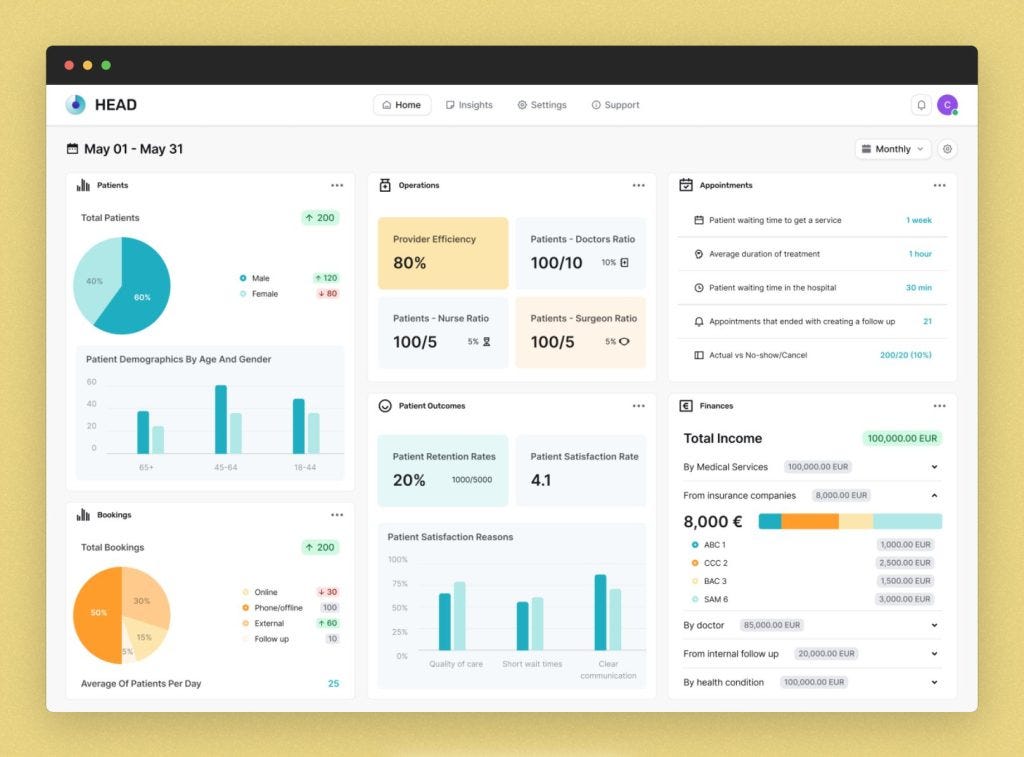
The most important management decisions sit at exactly this intersection. Which services are delivering value? Where is the resource being used without a clear return? Which parts of the network need attention? Answering these questions requires operational and financial data in the same view, at the same time.
Speed matters more than most leaders realize
Healthcare is fast-moving at the point of care. Management has historically operated on a much slower cycle, weekly meetings, monthly reports, quarterly reviews. That distance between what’s happening and when leadership finds out has real consequences.
A performance issue that surfaces on Monday and gets flagged in Thursday’s meeting has already caused three days of avoidable impact. A budget variance spotted at month-end has been compounding for four weeks. The faster leadership converts data into decisions, the less that preventable damage accumulates.
Leaders with real-time data also spend less time chasing information and more time using it. That shift in how leadership time is spent, away from data-gathering and toward decision-making, is often where the biggest gains are found.
Five principles for getting this right
- Start with the decisions, not the data. Identify which decisions you need to make faster, then work backwards to the information those decisions require.
- Bring everything into one view. Fragmented data produces fragmented thinking. Operational, clinical, and financial metrics need to be visible together.
- Define your own metrics. Build KPIs around your strategy and patient population, not a generic framework designed for a different organization.
- Set up early warnings. Define performance thresholds and automate alerts so issues reach leadership immediately, not in the next scheduled review.
- Use data to support your team, not scrutinize them. Visibility works best when it accelerates improvement, not when it creates fear. The goal is faster learning at every level.
The bottom line
Private healthcare is a competitive, margin-sensitive environment. The organizations that perform best are increasingly those where leaders have clear, current information and can act on it quickly.
Real-time performance tracking isn’t about adding complexity. It’s about removing it, replacing scattered reports, delayed data, and reactive management with a clear, unified picture that keeps leadership one step ahead.
The best-run clinics and hospitals don’t manage by looking backwards. They know what’s happening right now, and they act on it.