

We pulled utilization data across six specialties in private hospitals. Here is what high-performing departments actually look like, and where most fall short.
Calendar utilization is the most underreported metric in private healthcare.
Most Clinical Directors know their revenue figures.
Far fewer know what percentage of their doctors’ schedulable time is actually filled. Even fewer have an external reference point to judge whether that number is strong, average, or quietly eroding revenue.
Calendar utilization is one of the clearest indicators of operational performance in private healthcare. It shows whether existing capacity is being used effectively, whether demand is being converted into appointments, and whether departments are losing revenue without adding any visible cost.
SECTOR BENCHMARK AT A GLANCE:
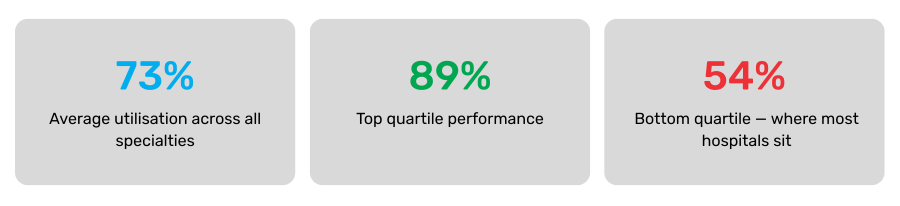
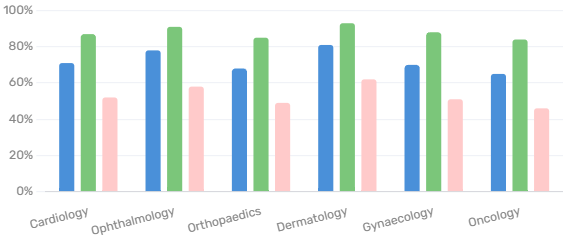
Utilization by specialty — private hospital average vs. top quartile
Percentage of schedulable slots filled per week.
Red line = cross-specialty average: 73%.
Key takeaway: Utilization varies significantly by specialty, but the performance difference between average and top-quartile departments is large enough to represent a major revenue opportunity without adding doctors, rooms, or operating hours.
Specialty deep dive
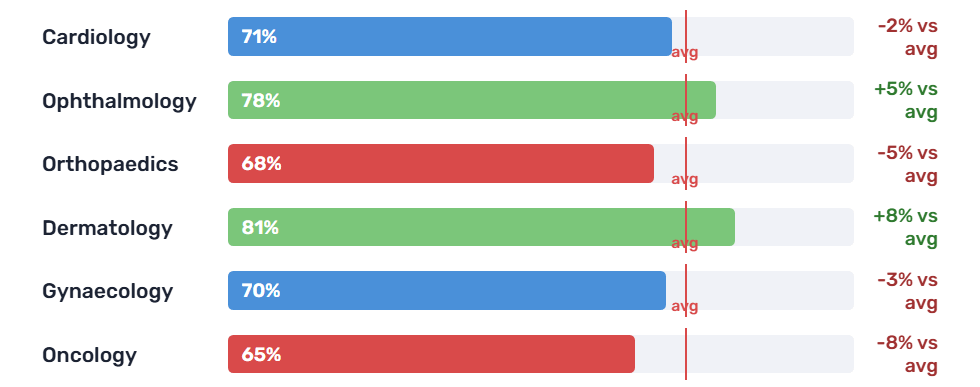
Specialty-level benchmarking often reveals that underutilization is not evenly distributed across the hospital.
Some departments may be operating close to full capacity, while others have recurring gaps by doctor, day, or appointment type. These gaps are often hidden when utilization is viewed only at hospital level.
The most useful benchmark is not only how one specialty compares with another. It is how each department compares with its own realistic top-quartile potential.
What separates top-quartile departments:
- They fill cancellations within 4 hours, not 48.Top-quartile departments maintain a live waitlist and assign clear ownership for filling same-week gaps as soon as they appear. Cancellations are treated as recoverable capacity, not as lost time.
- Booking windows are managed, not left open.High-utilization departments actively manage how far ahead patients can book. This helps concentrate demand into near-term availability before future slots are filled too early.
- Follow-up bookings happen inside the consultation.Every confirmed follow-up booked during the visit reduces the risk of future calendar gaps. Departments with a structured in-visit booking protocol show higher utilization because fewer patients leave without a confirmed next step.
- Utilization is a tracked KPI, not a quarterly figure.In top-quartile departments, calendar utilization is visible weekly – by specialty, by doctor, and by day. Gaps are identified before the week starts, not after the revenue has already been lost.
The number to know:
Every 1% improvement in utilization across a 10-doctor department can represent roughly 4-6 additional consultations per week.
At an average private consultation value of €300-€500, moving a department from 68% to 78% utilization is not a marginal gain. It can translate into approximately €60,000-€100,000 in additional annual revenue per doctor, using the same team, the same rooms, and the same operating hours.
How to benchmark your own department
To calculate utilization, take the total number of consultations delivered in a given week, divide it by the total schedulable slots available, and multiply by 100.
Do this by specialty and by individual doctor.
The gaps between doctors in the same department are often the most revealing part of the exercise. They show where demand, scheduling discipline, cancellation recovery, and follow-up booking processes are working, and where they are not.
Where call center performance enters the picture
Calendar utilization does not start inside the doctor’s schedule. It starts earlier with patient demand, call handling, appointment routing, cancellation recovery, and follow-up conversion.
A department may have available capacity, but if patient inquiries are not captured, routed, converted, or rebooked quickly enough, that capacity remains invisible until it appears as empty slots.
That is why call center intelligence is becoming a core operational layer for private hospitals. It connects patient demand to calendar performance, showing not only where appointments are booked, but where opportunities are lost before they ever reach the schedule.
Product update: Helping hospitals understand call center performance without compromising patient privacy
For hospital leaders, understanding call center performance is often harder than it should be.
- Which services are patients asking about most?
- How many inquiries turn into booked appointments?
- Where are calls being lost, and why?
- How clearly can marketing campaign performance be measured from first contact to conversion?
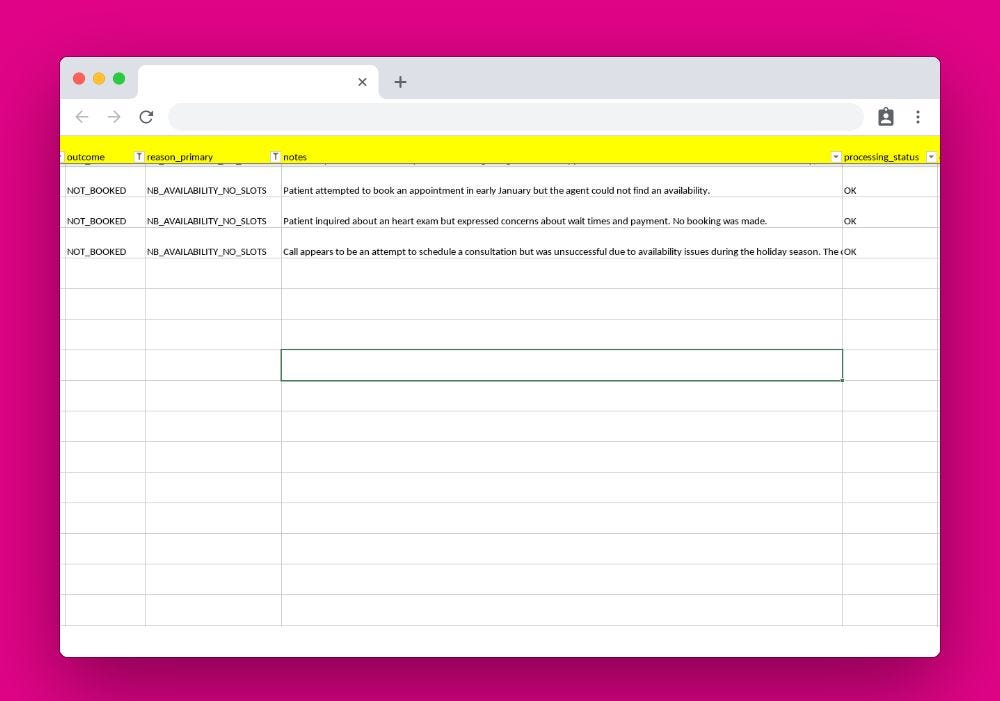
Our latest solution gives healthcare organizations clearer visibility into their patient communication channels, helping leaders understand call center activity, patient demand, appointment conversion, and missed opportunities.
Built with a privacy-first architecture for healthcare environments, the solution uses person anonymization, zero-trust access controls, and a zero-store data approach. Sensitive patient information is not exposed, retained, or made accessible beyond what is required for real-time analysis.
The result is a more complete view of call center and marketing performance, while supporting strong data protection, regulatory compliance, and patient trust.
For hospitals looking to improve utilization, this matters because call center performance is often where the first measurable opportunity appears. Better visibility into patient inquiries, booking outcomes, and lost demand helps teams understand why calendar gaps exist, and what can be done to close them.
Want to benchmark your department?
To benchmark your own utilization and call center conversion performance, start with three numbers:
- Total schedulable slots per doctor per week.
- Total completed consultations per doctor per week.
- Total patient inquiries that convert into booked appointments.
Together, these numbers show whether the issue is demand, conversion, scheduling, or cancellation recovery.
Hospitals that measure these consistently are better positioned to improve utilization without adding new doctors, rooms, or operating hours.