

How private clinics are losing patients, and revenue through an information they already have access to.
Private clinics think about patient reviews the same way they think about a hotel star rating. Nice to have. Good to monitor. Something to address when a negative one appears.
That framing is costing them patients and revenue every month.
Patient reviews are not a PR exercise. They are one of the clearest indicators in your patient journey, and when read correctly, they tell you exactly where your operations are strong, where they are failing, and which moments are making or breaking the decision to return.
The real value of a patient review is not the star rating
When a patient leaves a review, they are giving you something most operational data cannot: an unfiltered account of how your clinic actually felt to navigate.
They are not describing the EHR system. They are describing whether the receptionist made them feel welcome. Whether the follow-up call came when it was supposed to. Whether they were able to book again without three phone attempts and a callback that never arrived.
These are the moments that determine whether a patient returns. And in private healthcare, whether a patient return is a direct commercial variable.
A five-star review is not a sign that everything is working perfectly. It is confirmation that the patient journey, from first contact through treatment and follow-up, was smooth enough to deserve that rating. The question worth asking is: how much of that is by design, and how much is by luck?
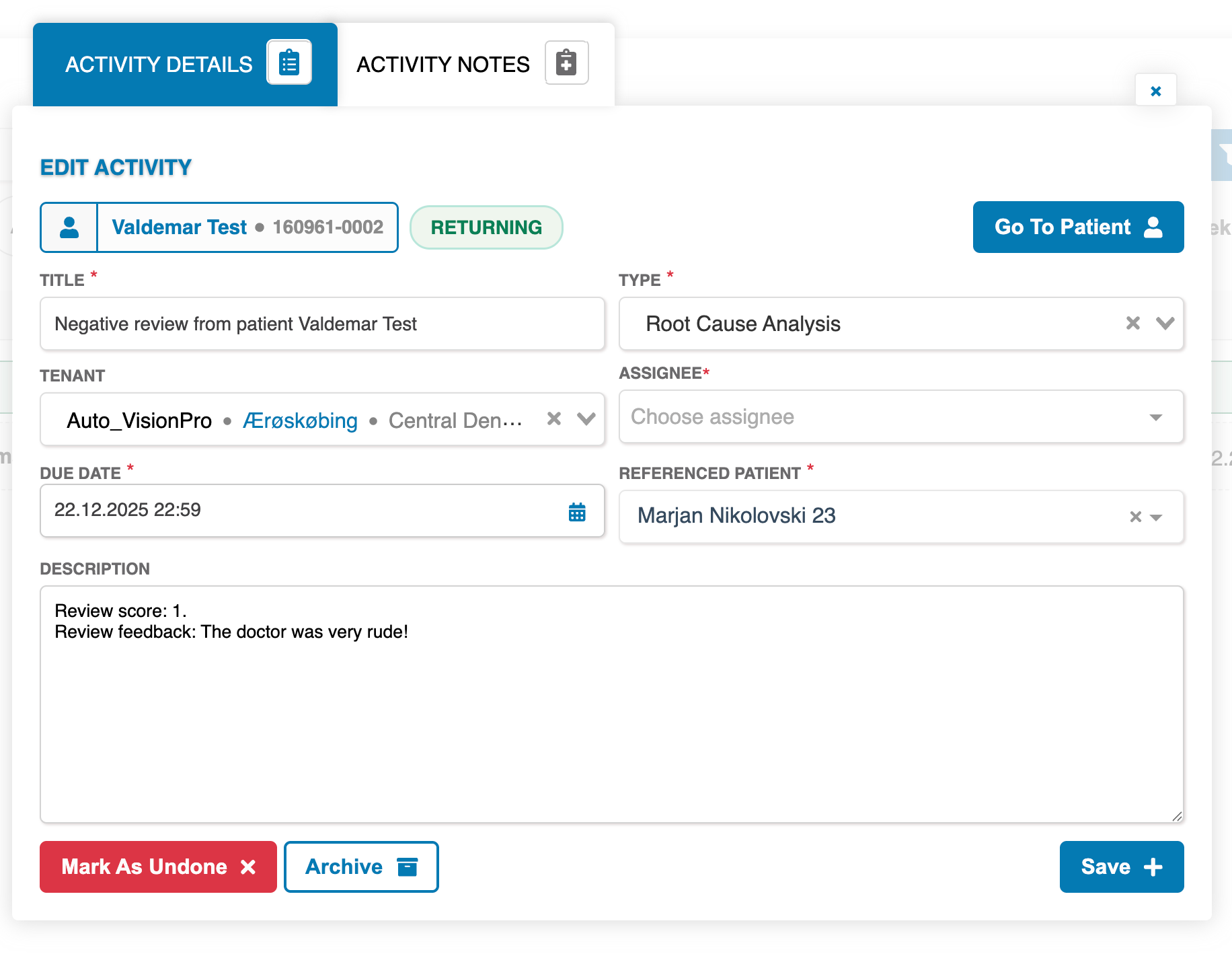
A two-star review, meanwhile, is indicative. It is telling you that somewhere in the journey, the experience broke down badly enough for a patient to stop and document it publicly.
Your Attractive Heading
When you read patient reviews at scale, patterns emerge that are directly connected to operational performance.
Booking experience. Reviews that mention difficulty scheduling, long waits for confirmation, or inability to reach the right person are symptoms of a booking system that is losing demand.
The patient eventually got through. Others may not have.
Follow-up and continuity. Reviews that mention being forgotten, not receiving post-visit instructions, or having to chase the clinic for results are describing a follow-up workflow that is not functioning. These patients often do not return, and they rarely complain loudly. They just disappear.
Communication consistency. Reviews that praise a specific staff member often signal that quality is being delivered by an individual, instead of a system. When that person is unavailable, the experience deteriorates, and the next review reflects it.
Staff experience and clinical quality. Positive mentions of specific doctors or nurses represent referral potential. These are patients who trust your clinical team and, given the right conditions, will recommend you. Capturing and acting on that trust is where clinics fall short.
When you stop reading reviews as reputation feedback and start reading them as journey diagnostics, they become one of the most actionable datasets you have access to.
The commercial case for taking reviews seriously
In private healthcare, a new patient acquisition is expensive. Marketing spends, digital campaigns, referral programs: all of this investment is aimed at getting a patient through the door for the first time.
A returning patient costs a fraction of that to keep.
Patient reviews directly influence both sides of that equation.
On the acquisition side, a strong review profile builds credibility before the first interaction. Modern healthcare consumers research providers before they book. They compare clinics. They read what other patients experienced. A clinic with consistent, recent, positive reviews converts a higher percentage of that research into bookings.
On the retention side, reviews function as a mirror. They show leadership where the journey is breaking down and where it is holding. Clinics that act on review patterns, not just acknowledge them, create measurably better patient experiences over time. Better experiences drive higher retention. Higher retention drives revenue that is sustainable, not just spiky.
Why clinics fail to act on reviews
The problem is rarely awareness. Clinic leaders know that patient reviews matter.
Reviews are often managed by a marketing function that has limited visibility into operations. The insight stays in the communications layer and never reaches the people who could actually change the workflows that are causing the problem.
There is no connection between what a patient said in a Google review and what the scheduling team, clinical staff, or operations manager sees in their daily work. The feedback loop is broken before it starts.
The second problem is volume and consistency. A clinic with multiple locations, dozens of providers, and hundreds of monthly appointments cannot meaningfully monitor and act on reviews without a structured system. When you are relying on someone to check Google manually twice a week, patterns are missed and responses are delayed.
The third problem is that positive reviews are not being actively generated. Most patients who have a good experience say nothing publicly unless they are prompted at the right moment, in the right way. Clinics that do not build that prompt into the post-visit workflow are leaving their review volume, and their credibility, significantly below where it could be.
How PEX connects reviews to patient journey management
This is where structured patient experience management changes the picture.
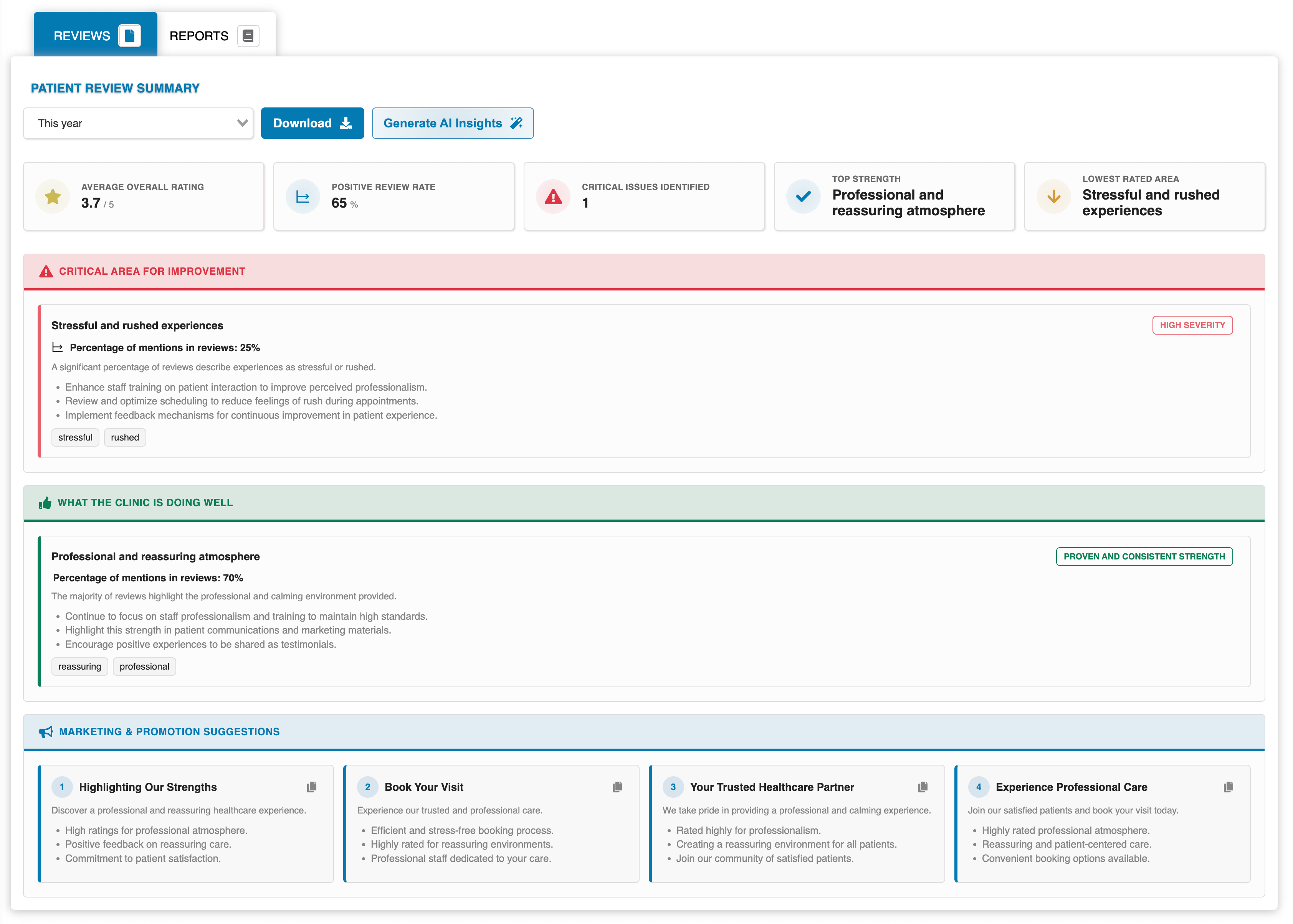
PEX, our hospital patient experience platform, is built to improve the moments in the patient journey where providers most often lose momentum, revenue, and continuity. Reviews sit within that context, not separate from it.
When a patient completes a visit, PEX supports structured follow-up workflows that reach the patient at the right time.
Patients who are engaged in a structured post-visit journey are significantly more likely to leave a review. More importantly, they are also more likely to return.
For clinics managing multiple locations, PEX provides visibility across the patient journey at a network level. When review patterns consistently surface problems at a specific location or in a specific specialty, that visibility allows leadership to act on the insight rather than discover it six months later.
PEX integrates with your existing EHR and HIS. It does not require you to replace core systems or force your workflows to adapt to our software. It works within your current infrastructure to improve the patient experience at the points where it matters most.
What good review management looks like in practice
It is not about responding quickly on Google. That is the minimum.
What good review management actually looks like inside a well-run private clinic:
Post-visit touchpoints are systematic, not ad hoc. Every patient who completes a visit receives a structured follow-up that is timed correctly, personalized to their journey, and includes a clear, low-friction path to leaving feedback. This is a workflow, not a task someone does when they remember.
Feedback reaches the right people. Operational insight from patient feedback does not stay in the marketing department. It is connected to clinical leads, operations managers, and where relevant, executive leadership. The people who can change the workflows are seeing the signals.
Patterns are tracked, not just individual reviews. A single negative review is not a crisis. A pattern of negative reviews about the same part of the journey is a red flag that requires operational attention. Leadership needs visibility into those patterns across time and location.
Positive reviews are connected to referral potential. Patients who give five stars and specifically mention a provider or a positive experience are candidates for a deeper engagement. They are more likely to refer, more likely to return, and more likely to become long-term patients if the relationship is managed thoughtfully.
Review response is brand-consistent and timely. Both positive and negative reviews receive responses that reflect the clinic’s values and communicate genuine engagement. This is not just about the reviewer. Every response is visible to the next patient who is researching your clinic.
The bottom line
Patient reviews are not a reputation task to delegate to a junior team member with a login to Google Business Profile.
They are a real-time operational indicator that tells you where your patient journey is working and where it is losing people. Clinics that read them that way, and build the systems to act on them, have a structural advantage over those that do not.
The patients who take time to write reviews are showing you the experience. The question is whether your organization is structured to hear what they are saying and do something about it.
If your clinic is losing patients to follow-up gaps, booking friction, or inconsistent communication, the review section of your Google profile already knows. The work is building the workflows that fix it.
EMIT KNOWLEDGE helps private hospitals improve patient retention, recover lost bookings, and build continuity of care that drives sustainable revenue. PEX is built to support that work from the patient journey layer, integrated with your existing systems, and designed around how healthcare actually operates.
If you want to understand where your patient journey is breaking down and how to close those gaps, we should talk.